
Where We Left Off
In June 2024, we shared an article on the introduction of the Camp Lejeune Justice Corrections Act and its promise to fix flaws in the original Camp Lejeune Justice Act of 2022. You can revisit that article here: New Bill Introduced to Expedite Justice for Camp Lejeune Victims.
That bill was meant to speed up justice for Marines, families, and civilians harmed by decades of toxic water exposure at Camp Lejeune. Yet, progress has remained painfully slow.
The Current Reality
-
3,580 lawsuits filed in the Eastern District of North Carolina as of August 22, 2025.
-
409,986 administrative claims submitted to the Navy.
-
162,340 claims include at least one supporting document.
-
63,129 claims allege injuries that could qualify for settlement under the Elective Option.
-
-
Despite this massive backlog, the Navy has confirmed that only 829 people have actually received settlements, totaling $223 million (Spectrum News, Aug. 21, 2025).
That means hundreds of thousands of families — many of them widows — are still waiting for the justice promised to them three years ago.
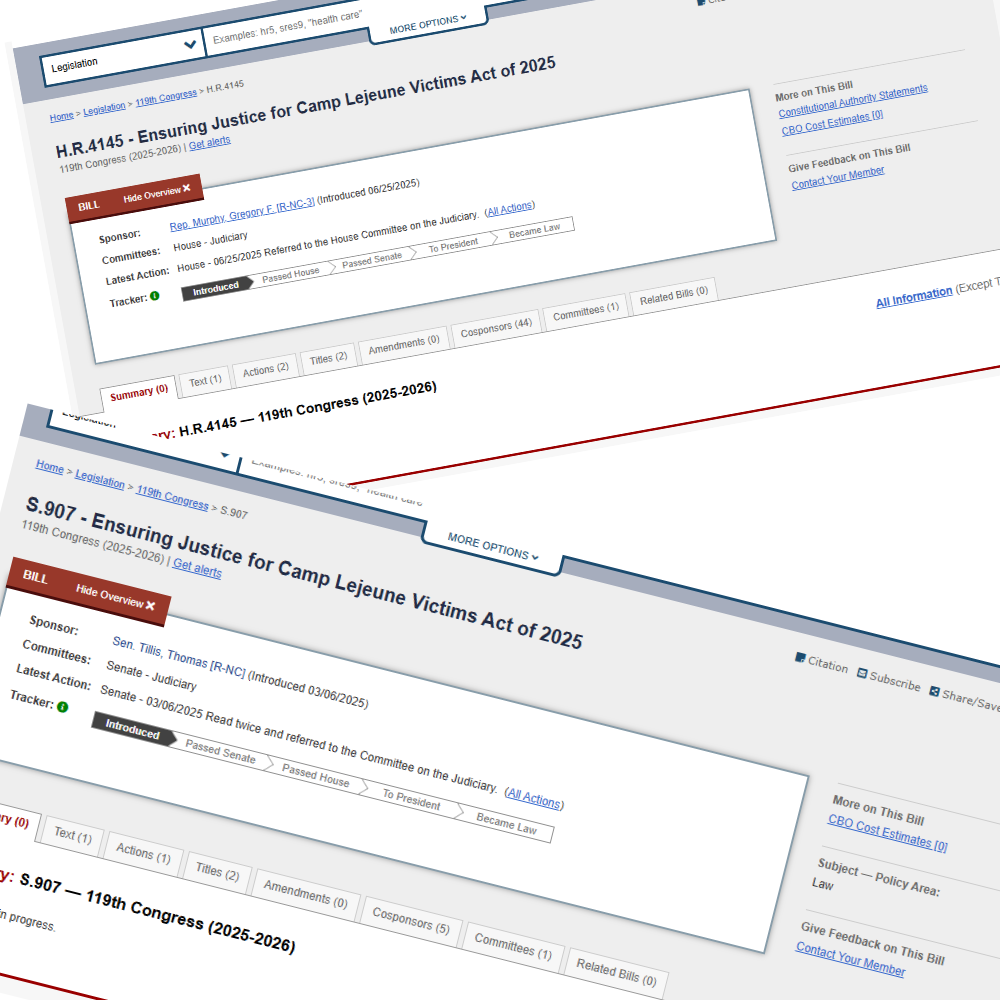
New Bipartisan Efforts: H.R. 4145 and S. 907
To address these failures, lawmakers introduced two critical bipartisan bills in 2025:
-
H.R. 4145 – Camp Lejeune Justice Corrections Act
Introduced in the House by Rep. Greg Murphy (R-NC) and Rep. Deborah Ross (D-NC), this bill:
- S. 907 – Ensuring Justice for Camp Lejeune Victims Act
Introduced in the Senate by Senator Thom Tillis (R-NC) and co-sponsored by Senators Richard Blumenthal, Amy Klobuchar, Todd Young, John Boozman, and Peter Welch, this bill mirrors H.R. 4145 and reinforces Congress’s intent to bring justice to families without unnecessary barriers.
Backed by Veterans’ Organizations
These bills have received broad support from leading Veterans Service Organizations (VSOs), including:
-
American Legion
-
Veterans of Foreign Wars (VFW)
-
Vietnam Veterans of America
-
Gold Star Wives
-
Iraq and Afghanistan Veterans of America
-
Tragedy Assistance Program for Survivors (TAPS)
-
Marine Corps League
-
Fleet Reserve Association
-
Non-Commissioned Officers Association
-
…and many more, including Lejeune Empowered Advocacy for Widows (LEAWS) itself.
Widely Covered in the Media
The national spotlight remains on this issue:
-
Spectrum News called the process a “slow train to nowhere” (Aug. 21, 2025).
-
The Washington Post profiled widows and families still fighting for justice (July 30, 2025).
-
CNN’s The Lead with Jake Tapper featured Rep. Ross and Rep. Murphy discussing the urgency of these bills (July 31, 2025).
-
Roll Call described the situation bluntly: “Death is the only winner so far in Camp Lejeune litigation.” (May 7, 2025).
Why This Matters
The Camp Lejeune Justice Act was a promise of recognition, accountability, and closure. But without these corrections, that promise is falling short. H.R. 4145 and S. 907 represent a renewed commitment to ensuring families don’t wait decades—or die waiting—for justice.
How You Can Help
-
Contact your Senators and Representatives: Ask them to support H.R. 4145 and S. 907.
-
Share your story: Every voice personalizes the need for urgency.
-
Stand with the widows and families: Together, we can push these bills across the finish line.
“Justice delayed must not mean justice denied. For the widows, the veterans, the families—this is our moment to demand accountability.”
Conclusion
The introduction of the Camp Lejeune Justice Corrections Act represents a significant advancement in the ongoing fight for justice for those impacted by the toxic water at Camp Lejeune. With the support of dedicated advocates and the new legislative measures, there is hope for faster and fairer resolutions for the victims and their families.